

Book Publishing Doesn’t Know What It Thinks About AI—and It Shows
A publisher’s take on why there are so many AI scandals in book publishing and why they will keep happening

It’s been a big but tragic week rife with AI book publishing scandals. Kathleen Schmidt, who covers a lot of these kinds of stories on Publishing Confidential, recently wrote that things cannot go on like this. But they will go on like this for a good long while because book publishing at large has no agreed-upon AI policy. It’s every publisher for itself, and we’re seeing the chaos and fallout and messiness that ensues when a meteoric event such as AI landing in our midst arrives without any instructions or guardrails or agreed-upon norms for how it should be used, followed by failure to act.
To track the events of just the past week:
July 27: The Atlantic published a story, “Is This What Comes After AI Slop?” on July 27 about H.M. Wolfe’s new novel, Daggermouth, asserting that the book was written with the assistance of AI. Many people are calling this a hit piece and suggest that it’s positive marketing for the AI detection tool Pangram (which I’ll get to below).
July 28: Daggermouth’s hardcover publication date—the book is released on Simon & Schuster’s Scarlett Press imprint. By all accounts, S&S is standing by the book and the author.
July 29: Jerry Falade, whose crime thriller, Call Me, I’ll Hide the Body, had been sold in a 14-way auction to Minotaur (an imprint of Macmillan), lost his agent (Europa) and his $2.4 million-dollar book deal after his agency sent an email to the acquiring publishers stating that they were “no longer able to authenticate how the manuscript fully evolved from origin to completion.”
These two books are being called the second and third major AI-related publishing scandals following the cancellation of Mia Ballard’s Shy Girl back in March, but there have been other notable scandals. Probably the biggest was in May with the publication and fallout around The Future of Truth: How AI Reshapes Reality, by Steven Rosenbaum, who confessed that quotes in his book were either misattributed or completely hallucinated by AI.
The Role of Pangram
Pangram is the AI detection software at the heart of these scandals, and people are up in arms about its imperfection and the probability of false positives. There’s a lot to digest on this front, but the salient question for me is whether feeding someone’s work into Pangram is potentially violative. I’ve done this now a few times when I’ve suspected an author has submitted AI-generated work to She Writes Press. The challenge for us is that we specifically have a disclosure question in our submissions process, which people ignore and/or lie about. More often than not I don’t need Pangram, by the way, but increasingly it seems to me that the blending between AI-generated and human-generated is the core challenge. Work that is 30% AI generated, for instance, means that writers are using AI to build out parts of their work. In other words, they’re using AI as a cowriter, something I’m imagining is increasingly common.
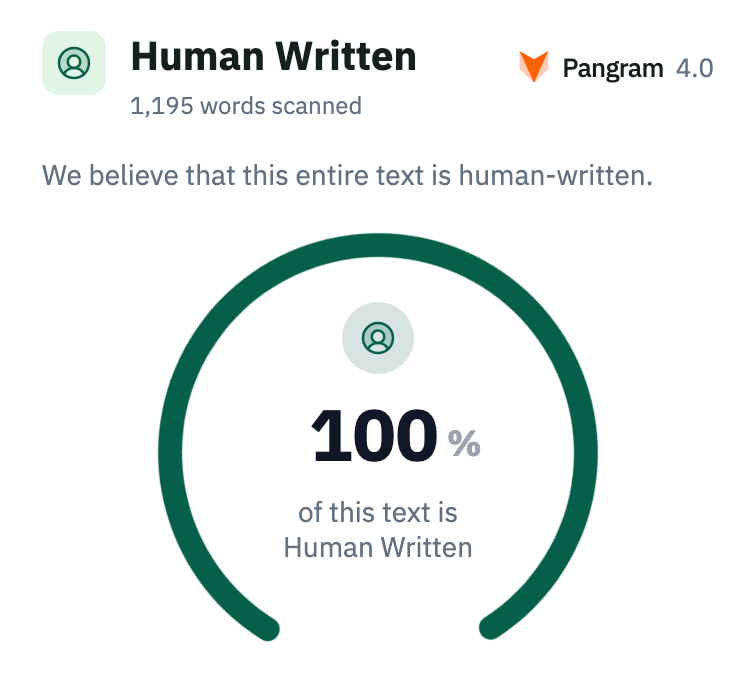
This is a tough reality for publishers because ostensibly if someone tells the truth about AI use, the publisher is not going to publish their work, and this is a question the industry is obviously grappling with, to incredibly inconsistent results. I’ll also note that I’ve fed my own work into Pangram. Here are the results for this post, and maybe my seventh time experimenting like this to see if I might pull up a false positive. I have not.
One of the better posts I read last week was by Sarah Fay of Substack Writers@Work in her post, “The Truth About Substack’s New AI Detection Tool,” in which she breaks down how Pangram works and why Substack’s announcement, “Against Claudefishing,” (also announced last week) that it’s partnering with Pangram is not a threat.
I’ll confess to feeling suspicious of people who are railing against Pangram because it makes me feel that they’re using AI in their writing process and don’t want to be found out. But even as I write these words, I acknowledge that suspicion is something I hate, and I use AI (not to write but in my writing process—through research and posing questions), so I’m applying completely personal measures to what I think is okay and what I think isn’t. But this is where we are—collectively and especially as an industry. And it’s going to eat us alive if we don’t figure out what to do.
Genre Bias
For anyone not familiar with the term “genre fiction,” it’s how the industry categorizes romance, sci-fi, fantasy, crime/thriller, horror, mystery, and now romantasy. A quick review of the three books that have been recently scrutinized/punished for AI use: Shy Girl is horror, Daggermouth is sci-fi/dystopian romance, and Call Me, I’ll Hide the Body is a crime thriller.
The bias in book publishing against genre fiction has deep roots. These genres have long been seen by the publishing elite as “lesser than.” Book publishing is legendary for its snobbery. A great piece just came out in June on ArtCulture UK called “The Silent War of Literary Hierarchies - Snobbery, Genre, and the Future of Reading” for those interested in the long-standing second-class treatment of genre writers. The writer, Yulia Tulegenova, draws attention to the tension underlying a new world order where BookTok and readers online are driving the sales of self-published titles that are subsequently getting major book deals (like Shy Girl and Daggermouth). Book publishers want to publish books of literary merit, but they also want to sell books. And the best-selling books are genre fiction. But how publishers treat these books and these authors is not disconnected from this broader story.
In short, there’s a reason we’re seeing these scandals rocking the world of genre fiction as opposed to literary or upmarket or historical fiction. You can break it down into two categories: 1) The authors are less likely to be trained writers coming out of MFA programs. Their writing is propulsive and for the masses, by design, and they may not hold themselves to the same literary standards, and I don’t mean that as a criticism. 2) The readership is enormous and very online, which means there’s going to be a lot more fans, but also a lot more scrutiny (like Reddit threads and social media influencers who make it their job to pick apart every single detail of a book). I personally found it insane when I came upon Frankie’s Shelf YouTube video about why he thought Shy Girl was AI slop, not so much because I didn’t like his content but because the video is three hours long! These readers not only have time on their hands, but the communities dedicating themselves to reading, criticism, fandom, etc. in genre fiction is unlike anything I’ve seen in other genres.
The Race Question
Rightfully, people have noticed a commonality among these three authors. They’re all writers of color. I’ve read many posts by people decrying the double standards. White authors are getting away with using AI, or admitting to AI use and not being punished in the way these authors have been. The only challenge with this argument is that Wolfe’s publisher is standing by her. But Daggermouth is also a published book as of July 28. It’s very difficult to unwind a book’s publication when the print run has already landed in the warehouse, and the preorders have shipped.
Regardless, it’s extremely important that the industry answer to this critique because we have a race problem in book publishing going way back. That the lack of any policies, rules, or regulations around AI use puts human impulse at the center of all decision-making around which books move forward is cause for concern. It means that outcomes will be uneven, and definitely biased. This should make us uncomfortable.
Each of these authors has responded differently to the accusations leveled against them, and my feeling is that the onus is on book publishers to be clearer and more consistent around what is okay and what is not okay when it comes to AI use. We are not consistent. We don’t even know what we think is okay. In each of these cases, my sympathy really does lie with the authors because I don’t think any one of them set out to dupe their readers or get away with something. More people than not are using AI, and book publishing sucks at policing.

***
It’s right for us to have mixed emotions, and not to know how to feel about the real-world consequences—for writers and authors, for editors and agents, and for the publishing community at large—of how this technology is unfolding.
AI has unleashed a toxic mix of paranoia, accusations, superiority, purity tests, cancellations, scapegoating, and unequal treatment of authors. We are in desperate need of industry-wide standards. Instead, we’re left with case-by-case improvisation, and individual authors like Ballard, Wolfe, and Falade then pay the price for the industry’s systemic inaction and hand-wringing. Dear God, we have to do better.
The one problem I have with AI detection tools is the issue I had previously with plagiarism detection tools. If a student wrote and submitted a draft, then later submitted a revision of that paper, it got flagged as plagiarism. Of their own words? Likewise, the tools ignored quotation marks, so legitimately cited material was also marked as plagiarized. I took more time unscrambling the machine report than just evaluating the writing myself. And I think most experienced teachers have a good “feel” for what their students can and can’t write.
So can’t most agents and publishers innately tell when submitted writing is somehow off? Why use AI to detect AI? Simply to give the appearance of neutrality? Are these programs indeed neutral?
Honestly, I think this says more about "big" publishing's gatekeepers than AI or the sloppy authors who use it. A 14-way auction for something that turns out to be AI-tainted? What a bunch of rubes.