

How Could This Have Happened?
A Publisher's Take on How an AI-generated Book Got Acquired by a Major Publisher, Why No One Flagged It as Problematic, and Why Shy Girl is a Bellwether

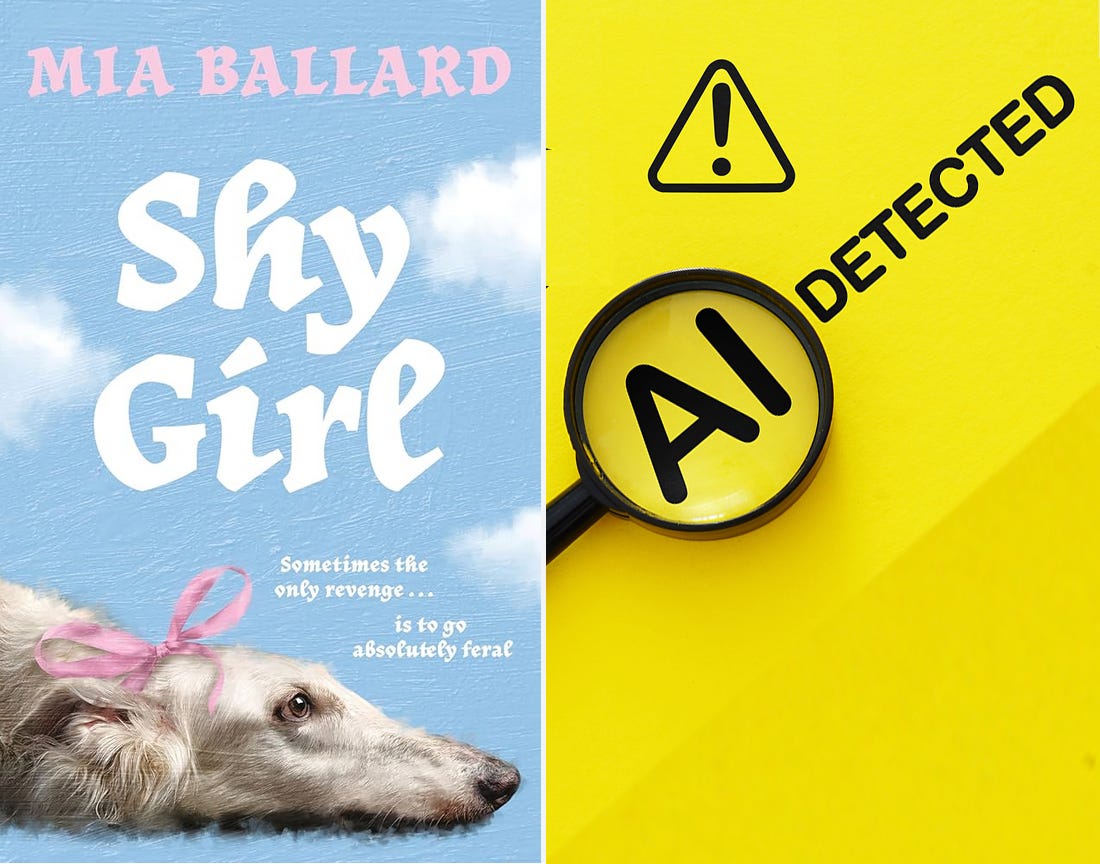
The cancellation of Mia Ballard’s Shy Girl by her publisher, Hachette, is big news in book publishing because this is the first book (we know of, anyway) to be canceled by a major publishing house for using AI to create or co-create (or what publishers would call author or co-author).
Quick recap:
• February 2025: Shy Girl is self-published and well-received (4,900 ratings on Goodreads, and averaging 3.52 stars, according to the NYT).
• July 2025: Despite knowing that the author lifted the artwork of Whyn Lewis for her self-published edition (which is a whole other side story worth looking into because it speaks to the author’s complete lack of regard for ownership), Hachette US buys the North American rights to Shy Girl.
• November of 2025: Hachette UK publishes its edition with a new cover.
March 19, 2026: Hachette US (with yet another variation on the cover) announces it’s canceling publication of the North American edition, set to come out in April.
This story has been widely reported on this week already, so read here if you’re interested in the breaking news (New York Times); what it means (Counter Craft); and now what? (Paper Trails).
At the center of this controversy, of course and however, is what the hell is publishing doing about AI-written books and how could this have happened? Which is where I come in.
Today’s post breaks down what each of these above outlets/newsletters have to say about the publishing part, followed by my take.
New York Times
The stunning fact that “Shy Girl” got so far into the editorial process, and was even released in the U.K. before publishers thoroughly investigated the claims of A.I. use, is a sign of how unprepared many in the book world are to deal with the rise of A.I.
“It’s like with plagiarism — you’re at the mercy of the author,” said Morgan Entrekin, publisher of Grove Atlantic. “We have to have confidence in our partners.”
Both things are true here. It’s stunning that Shy Girl got so far into the editorial process before anyone asked any questions, and publishers are at the mercy of our authors.
When I was a young editor at Seal Press (now an imprint of Hachette—small world), I discovered that one of my authors had plagiarized major sections of her book. The only reason I found out was because the author had left hyperlinks in the manuscript and I clicked on one. It sailed me right over to a Wikipedia page, where I proceeded to read, verbatim, lines and lines of text I’d just read in my author’s manuscript. Feeling a bit sick, I cut and pasted at random other full lines from the manuscript into Google to see what would happen. Nine out of ten efforts led to verbatim hits on various sites online. When I presented this to my boss, she was shocked. It was blatant plagiarism, and we canceled the book.
I caught this author red-handed, but I wouldn’t have if she hadn’t left the Wikipedia hyperlink in her manuscript, and if I hadn’t clicked through, because I wouldn’t have recognized the writing as not hers.
And by the way, the definition of plagiarism is knowingly passing off someone else’s work as your own. It’s shocking to me that we are not calling lifting text from AI what it is: plagiarism. Is it only because it’s not someone, but rather something, from which we are taking text and passing it off as our own? Just because we can’t attribute the exact author to the work doesn’t make it any less plagiarized.
AI is also bringing to the fore a lot of ethical questions about disclosure, of course. We want authors to disclose their use of AI, but at the same time they’re being shamed and rejected when they do so. On two occasions now I’ve suggested to authors that they not disclose to publishing insiders that they’re using AI, which just makes me complicit in propagating willful ignorance: see no evil, hear no evil, speak no evil. It’s not tending to a solution, I know.
The Times suggests that the publisher should have investigated the accuracy of Shy Girl, especially considering that there was speculation about it on Reddit threads as many as ten months ago. But this suggests that publishers care about Reddit threads. Communities on Reddit, by and large, view traditional publishing as exploitative and increasingly irrelevant, so it’s hardly a place where you’ll see a lot of Big House editors chilling out, asking questions, or going down rabbit holes.
Lincoln Michel at Counter Craft
Many may wonder how a book this poorly written and also probably AI-generated—again, there were rumors and viral videos about how bad this book was—could have gone through the vetting process and layers of gatekeepers in publishing. Well, it probably didn’t. It was self-pubbed and seemingly sold without an agent. When a US publisher acquires an already published book, it is rare to do much editing. So, the question is how much editing did Hachette UK do? I have no inside knowledge in this case. My suspicion is not much editing was done. Probably a copyedit and proofs for typos. Perhaps nothing more. Again, maybe I’m wrong. But it seems hard to believe a book with this many issues was published with a rigorous vetting process.
I agree with Lincoln that probably very little editing was done. Also, most people really don’t get just how few people interact with an author’s book once it’s signed, so let me lay out the quick and dirty here.
Manuscripts are acquired by editors. If a book is agented, it’s possible/probable that the agent did a fair amount of editing prior to submitting to the publisher. If the book was previously self-published, as was the case with Shy Girl, the only person to interact with the text before the house acquires the book is the acquiring editor. She (usually a she) is responsible for bringing to Editorial Board the work she wants to acquire. She makes the case for the book by sharing whatever might be required: P&L (maybe); sales track (if there is one); author platform (of utmost importance); and her own passion for the project.
The acquiring editor on this project is a young editor who graduated from NYU in 2019. No shade here for how young she is because I’ve been her. But what I will say is that publishing houses put a shitload of responsibility on very young editors, and world-weariness and experience do play a role in what you’re likely to “catch” when it comes to having to fucking call out your authors.
It’s not easy to raise the alarm bell on a book you acquired. Acquiring editors have a lot of pride for books they’re able to “get through” the acquisitions process (and there are quotas to boot). In this case, the book was already published by Hachette UK, which means it was pre-vetted. If Hachette US was excited about the book, and this young editor had few books to her name (which indeed seems to be the case), then it’s sort of self-sabotage to raise any red flags. And that’s if she even saw any red flags. She might not have. The world is changing so fast, and younger editors reflect the world around them, for better and for worse. Young editors bring a kind of energy and finger-on-the-pulse understanding of what’s trending that older editors grow out of with more jadedness, whereas the experience of older editors is probably exactly what you want and need when it comes to detecting bullshit. But, books have the editors they have.
Finally, even if the book were copy edited and proofread, that would have been by contract editors, who are similarly not tasked with bringing concerns to publishers. I work hard to encourage my editors to do so. Tell me/us when things aren’t working in the manuscript! Flag issues! That said, editing is subjective. One person’s editorial concerns might be another person’s nothingburger. Which is why all of this is so gosh-darned fraught!
Marcus at Paper Trails
I think this case study is fascinating because it highlights the complete power imbalance in publishing. The publisher’s cancellation of the book further fuels the speculation and places the blame squarely on Ballard. Even if the manuscript was AI-generated, what onus does the publishing company have on detecting this? They were fine to turn a quick profit from a book already proven to be commercially viable, but it does not seem that they provided sufficient infrastructure to Ballard through the acquisition or editing of the book.
So, where does publishing go from here? How do authors protect themselves against accusations of using generative AI? What responsibility does the publisher have versus the author? Hachette has set a precedent that is difficult to come back from, and without a definitive conclusion, readers are left to speculate.
Marcus speculates in his piece that Hachette is not without blame. I don’t disagree, but I also want to say that AI just landed on us like a ship from outerspace and we’re all scrambling to figure out what we’re supposed to do and how to react to it. Perhaps Mia Ballard didn’t get enough support through the acquisitions process. And yet, if it had come to light during the editorial process that the book was this AI-generated, the contract would have been canceled much earlier. It’s not like Hachette would have said, Oh Mia—you poor thing. You had to use AI because you didn’t have enough editorial support. You lifted a cover off of Pinterest without permission because you didn’t have enough design support. No, that’s not how it goes. Publishers have little sympathy and much contempt for this kind of behavior, and so she just would have been canceled sooner, and it would have saved Hachette the public embarrassment.
Meanwhile, I’m not here to let all of publishing off the hook. Publishing has problems, obviously. Namely:
1. There are not enough measures in place for how or whether to raise questions about authors who lie or lift or plagiarize. If an editor suspects their authors of wrongdoing, and especially if the editor is green, they’re likely nervous to raise any suspicions.
2. Publishers do not fact-check, by and large. There’s no process or expectation in place for editors to even Google their authors or to go see what conversations might be happening, anywhere and especially on Reddit. Publishing is very insular, so the information we get about our authors comes from the authors themselves, and from their agents if they have one. We trust them. So yes, publishing needs to be more skeptical. We need to treat every author, unfortunately, as someone to be vetted. This sucks and it makes me sad, but given how much lying and bad behavior there is in the sector beyond AI, we have to adapt and become more cynical. Thank you, AI.
3. We have to update our contracts. The NYT piece says:
Publishers have maintained a firm line against A.I.-generated text and images, and require authors to attest that their work is original in their publishing contracts.
It’s true that most publishers have maintained a firm line against A.I.-generated text and images, and yes, publishers ask authors to attest that their work is original. But most authors really don’t see AI-generated writing as plagiarism, so they’re more than happy to sign the contract that says they’re the sole author of the book. This is from a Hachette template that I procured from a colleague:
WARRANTIES: Author warrants, represents and covenants that: (i) Author owns all rights granted in this Agreement free and clear of any encumbrances, Author has the full power to enter into this Agreement, and performance hereunder does not require the consent or approval of any third party individual, entity or governmental agency; (ii) the Work is original with Author in all respects, except for any material identified by Author as previously published, or owned by a third party and used with Permission, or in the public domain; (iii) the Work, including the title (if provided by Author), does not infringe upon any copyright or trademark, plagiarize others’ work, contain any matter that is libelous or an invasion of privacy or a violation of any other right, law or regulation, or include any material provided to Author in confidence or on the understanding it would not be published; (iv) to Authors knowledge, there are no claims pending or threatened that might adversely impact the publication of the Work, and Author will promptly notify Publisher in writing.
Publishing will need to adopt new language in our contracts that explicitly states something to the effect of:
Author has not used LLMs (Large Language Models), otherwise known as AI to write or coauthor any portion of the Work.
In addition to adding language that requires authors to assert that they are not using AI to write their books, publishers need to assert contractually that they are not using AI to generate art, or to edit, or to design books. We need contracts that acknowledge and honor that human expression is sacrosanct.
Publishing didn’t ask for AI, and yet here we are at the epicenter of it all. Does it irk me that publishing is now expected to hurry up and get its shit together around how we’re supposed to deal with AI when LLMs would not exist in the first place if it weren’t for the massive amount of data that AI companies took without permission from publishers and authors? Yes, it most decidedly does. But here we are, and Shy Girl is a bellwether.
On my most cynical days I feel like the publishing industry is so underwater on this thing that we’re too far gone, that AI is a virus we will never be able to contain or put boundaries around; on my better days I remember that we’re on the front lines, and together we can come together and create guidelines and expectations. There are legal contracts, but there are also social contracts. When I say we’re all in this together, I mean writers, publishers, and readers. I mean editors, designers, and industry professionals like booksellers and librarians and sales reps. There is much at stake, and at the center of this controversy is how we, collectively, feel about the irreplaceable thing that gets lost when human expression is devalued—and what we’re going to do about it.
Brooke, AI is a headache that won’t be going away any time soon, but In my opinion, this story also points to how many publishing houses are selecting books. An author having a large social media and proven record of previous sales does not necessarily equate to quality/original writing. But publishers are generally looking to make investments on what they consider sure shot deals. Generally, tastemakers don’t drive decisions these days. Sales do. (I’d like to state here that I have not read the book mentioned and am not commenting on this specific case.)
Brooke, your essays are among the few I read diligently every time I receive them. You are writing about subjects I am not seeing anyone else on Substack cover, and I thank you for that.
I also want to say that the use of AI is confusing. I use AI: for meal prep, to research bargains for a specific item in my area, to inquire about updated laws for teens who get their drivers permit, for dream interpretation.
I also ask AI to help me come up with outlines for an essay when I have a voice note I've recorded and transcribed and uploaded. I ask it to reflect back to me my marketable skills after I've collected a handful of testimonials from people who give me permission to publish them. I ask it for editorial feedback (not rewrites) on essays I'm workshopping.
And I am writing this to you with hesitation, because I feel...strange in admitting this.
In conversations with others who use AI for various reasons, it seems everyone ends up apologizing: AI is bad for the environment (it is, of course); AI can't be trusted (absolutely agree, which is why I fact-check with information on personal research). It's almost like AI is 100% evil, and I happen to disagree.
I think it is a tool, but I do not believe it should ever replace human connection/relationships, nor do I believe it should be used to create content, images or stories.
I guess I'm just sharing this, because using AI ethically really can be confusing, yet I don't necessarily believe it should be entirely avoided. Is there anything, anywhere that can guide an author who is ethically minded to understand specific "no nos" in using AI as a thought partner for their creative work?